What are spigot rings, and how do I measure for them?
Spigot rings are also called hub centric rings or wheel centring rings. They are small rings that fill the gap between your car’s hub and the centre bore of an alloy wheel. Aftermarket wheels are often made with a large centre bore so one design can fit many cars. Without a ring, the wheel is centred only by its bolts or nuts, and it can sit a fraction of a millimetre off-centre. That is enough to cause a steering-wheel shake at motorway speeds.
The two sizes you need
- OD, outer diameter: the size of the hole in the back of your wheel (wheel centre bore).
- ID, inner diameter: the diameter of your car’s hub spigot, the raised lip the wheel sits on.
A ring listed as 72.6 → 57.1 mm fits a wheel with a 72.6 mm bore onto a 57.1 mm hub.
How to measure in 4 steps
- Remove one wheel. Clean the hub lip and the wheel bore, because rust or dirt will spoil the reading.
- Measure the hub across its widest point with a digital or vernier caliper, using the outside jaws. That is your ID.
- Measure the wheel centre bore from the back of the wheel, using the inside jaws. That is your OD.
- Round to the nearest 0.1 mm and pick the matching ring. If you’re between two sizes, measure again or check the wheel maker’s spec. Many wheels have the bore size stamped on the back.
Typical hub sizes by make
| Make | Typical hub (ID) |
|---|---|
| Alfa Romeo | 58.1 mm |
| Audi | 57.1 mm / 66.5 mm |
| BMW | 72.6 mm / 66.6 mm |
| Citroën | 65.1 mm / 58.1 mm |
| Dacia | 60.1 mm |
| Fiat | 58.1 mm |
| Ford | 63.4 mm / 57.1 mm |
| Honda | 64.1 mm / 56.1 mm |
| Hyundai | 67.1 mm / 54.1 mm |
| Jaguar | 63.4 mm |
| Jeep | 71.6 mm |
| Kia | 67.1 mm / 54.1 mm |
| Land Rover | 72.6 mm / 63.4 mm |
| Lexus | 60.1 mm |
| Mazda | 67.1 mm / 54.1 mm |
| Mercedes-Benz | 66.6 mm |
| MINI | 56.1 mm / 66.6 mm |
| Mitsubishi | 67.1 mm / 56.1 mm |
| Nissan | 66.1 mm / 60.1 mm |
| Peugeot | 65.1 mm / 58.1 mm |
| Porsche | 71.6 mm |
| Renault | 60.1 mm |
| SEAT | 57.1 mm |
| Škoda | 57.1 mm |
| Subaru | 56.1 mm |
| Suzuki | 60.1 mm / 54.1 mm |
| Tesla | 64.1 mm |
| Toyota | 60.1 mm / 54.1 mm |
| Vauxhall / Opel | 65.1 mm / 56.6 mm |
| Volvo | 63.4 mm / 65.1 mm |
| Volkswagen | 57.1 mm / 65.1 mm / 71.6 mm |
Indicative values for common models. Some models use a different hub.
Fitting
- Push the ring onto the hub, or into the back of the wheel, with the flat face towards the wheel.
- A tiny smear of copper-free anti-seize helps with removal later. Keep it off the wheel’s contact face.
- Fit the wheel and tighten the bolts or nuts in a star pattern to the torque your car’s maker specifies. Re-check the torque after 50–100 km.
BBS wheels: rings with a spring retaining clip
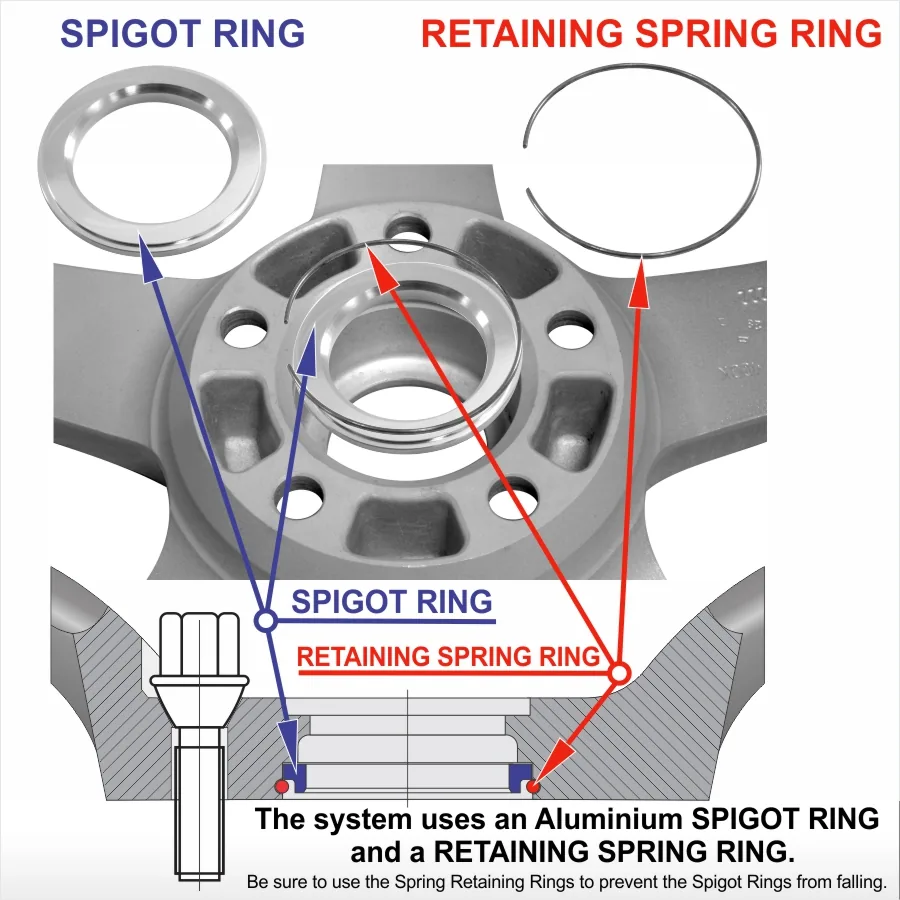
Many BBS wheels (and some other makes) hold the spigot ring in the wheel with a spring retaining ring. The aluminium ring has a groove, and the spring clip snaps into the groove and into the wheel bore so the ring stays in the wheel when you take it off the car. We sell complete sets (ring + clip) in 70.0 mm and 82.0 mm OD, and the clips separately. Shop BBS rings →
Polycarbonate vs aluminium
| Polycarbonate | Aluminium | |
|---|---|---|
| Corrosion / seizing | Never corrodes, won’t seize | Can bond to the hub if left for years; use anti-seize |
| Heat | Continuous use up to 140 °C | Unaffected by brake heat |
| Best for | Everyday road cars | Spacers, heavy wheels, track days |
| Price | Lowest | Higher |